Understanding police scanner codes lets you follow emergency radio traffic in real time.
Most people hear numbers like “10-4” or “Code 3” and have no idea what officers are actually saying.
Read on and you’ll learn what the most common codes mean, how they differ by state, and which free apps let you listen to live police radio right now.
What are police scanner codes
Police scanner codes are short number or letter combinations that officers use over radio to communicate quickly. Instead of saying “I’m on my way to the scene,” a dispatcher says “10-76” and every unit on the channel understands immediately.
Two main code systems exist in the U.S. The first is the Ten-Code system, developed in the 1940s for radio efficiency. The second is the Penal Code system, used mostly in California, where officers cite actual law numbers instead of ten-codes.
Many agencies have also adopted their own local variations. So a “10-50” might mean “traffic accident” in one county and “domestic disturbance” in another. Always check your local department’s published code list when possible.
The most common 10-codes you’ll hear on a police scanner
Ten-codes are the backbone of radio scanner codes across most of the country. Here are the ones that come up in almost every scan session.
Beyond ten-codes, you’ll also hear color codes (Code 2, Code 3) that indicate urgency levels. Code 3 means lights and sirens: officers are responding to a critical call right now.
Law enforcement scanner codes by incident type
Law enforcement scanner codes cover everything from minor calls to active emergencies. Knowing the category helps you understand the severity fast.
Police radio scanner codes vs. plain language: what changed
After the September 11 attacks in 2001, the U.S. Department of Homeland Security recommended that agencies drop ten-codes in favor of plain language communications. The concern was interoperability: when officers from different departments work together, mismatched code systems cause dangerous confusion.
Many large urban departments followed the recommendation. The NYPD and Los Angeles PD shifted largely to plain language for major incidents. Smaller agencies, county sheriffs, and fire departments often kept their ten-codes, though.
ℹ️ Importante: If you scan a channel and hear plain sentences instead of numbers, that’s intentional. It doesn’t mean the scanner app is broken: it means that department made the switch.
Free apps to listen to police scanner codes live
You don’t need a physical radio anymore. The best police scanner frequency apps stream live audio from real dispatch channels, including fire, EMS, and local police.
- Broadcastify: the largest free database of live police and fire audio feeds in the U.S. Available on browser and mobile.
- Scanner Radio: Android and iOS app with one-tap access to thousands of local feeds sorted by location.
- 5-0 Radio Police Scanner: popular on iOS, lets you filter feeds by city, county, or state.
- Radio Scanner (by Radioline): good for international feeds and less-common frequencies.
All of these apps are free with optional paid upgrades. The free tier gives you access to the major local feeds, which is enough for most listeners.
Is it legal to listen to police radio scanner codes
In the United States, listening to cop scanner codes and police radio is legal under federal law. The Electronic Communications Privacy Act of 1986 permits scanning radio frequencies that are not scrambled or encrypted.
Two important limits apply. First, you cannot use scanner information to help someone evade law enforcement: that is a criminal offense. Second, some states have specific laws about scanner use while driving. Illinois and Indiana, for example, restrict having a scanner active in a vehicle if you’re in the process of committing a crime.
⚠️ Atenção: Many modern police agencies in large cities now encrypt their digital radio channels. If you can’t hear anything on a known frequency, encryption is the likely reason: a scanner app or hardware device won’t get around that.
SDPD scanner and major department feeds
The SDPD scanner (San Diego Police Department) is one of the most-searched feeds in the country. You can find it live on Broadcastify under “California → San Diego County → San Diego Police.”
Other popular department streams include the LAPD, Chicago PD, Miami-Dade, and Houston PD. Most major city departments still have at least partial unencrypted channels you can access for free.
Fire and EMS feeds from these same cities are generally easier to access than police feeds, since fire departments have been slower to encrypt their communications.
How to use scanner codes to follow an emergency in real time
Listening without knowing the codes is like watching a film with the sound off. Here’s a practical approach to make sense of what you hear when you tune into a live feed.
1Identify your local channel
Open Broadcastify, search your city or county, and pick the main police dispatch feed. That’s where the highest volume of code traffic will be.
2Keep a reference list open
Search “[your city] police 10-codes” and download or screenshot the official list. Local code sets differ from the national standard in small but important ways.
3Listen for location first
Every dispatch starts with a unit number and a location (the “10-20”). Once you catch those two pieces, the code that follows tells you what’s happening there.
With a bit of practice, you’ll start recognizing code clusters. A call that opens with a 10-38 (traffic stop) followed quickly by a 10-27 (license check) and 10-28 (vehicle registration check) is a routine stop. A 10-33 that cuts in is something else entirely.
What Uniden scanner radios offer that apps don’t
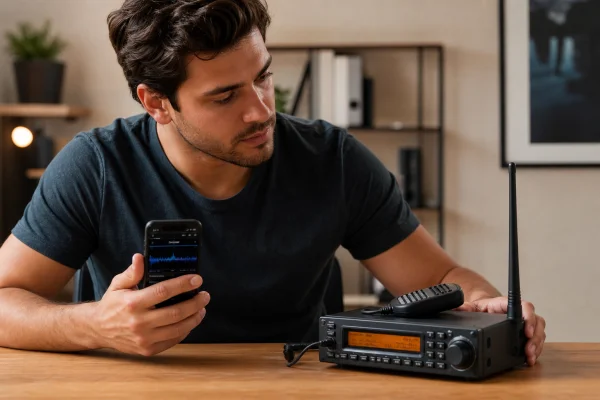
A Uniden scanner radio gives you access to frequencies that streaming apps can’t always carry. Dedicated hardware scanners pick up police radio scanner codes directly off the air: not through an internet relay that adds delay or drops encrypted channels entirely.
The Uniden SDS100 and BCD536HP are two of the most popular models among serious hobbyists. They support digital P25 Phase II trunking, which covers most modern police department systems.
For casual listening, though, a free app paired with this code reference is more than enough to follow what’s happening in your area.
Scanning is a legal, low-cost way to stay informed about local public safety activity. Bookmark a code list, pick an app, and you’re ready to tune in today.
ℹ️ Importante: This content is independent and informational only. We have no affiliation, sponsorship, or control over the agencies, apps, or platforms mentioned. For official frequency and code information, always consult your local law enforcement agency directly.