The best apps to learn piano teach you to read sheet music, play songs you actually want to play, and build technique step by step: all from your phone or tablet connected to a keyboard.
You no longer need a weekly teacher to make real progress on piano. The top apps now combine structured lessons with real-time feedback that listens through your device’s microphone and tells you immediately if you played a note wrong.
Here’s how the leading options compare and which one fits your situation.
What to look for in a piano learning app
A good piano app does three things: teaches music theory alongside songs, uses real-time feedback to catch mistakes as you play, and gives you a learning path that progresses logically instead of random songs. Apps that just show you popular songs without teaching rhythm, fingering, or reading music produce players who can only play what they’ve memorized.
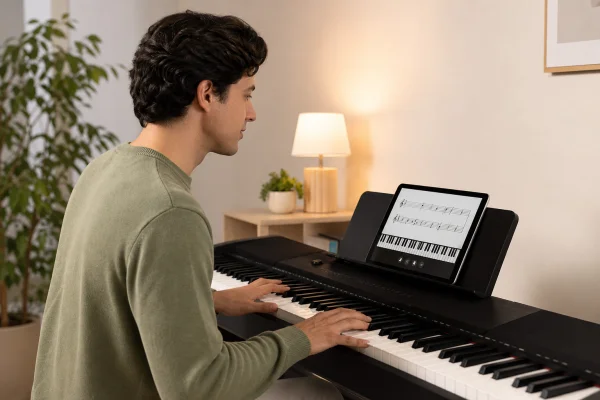
Most apps connect to your keyboard via Bluetooth or MIDI. An acoustic piano works too since the apps listen through the microphone, though MIDI connection gives more precise feedback. A keyboard with at least 61 weighted keys is the recommended setup for any serious practice.
Best apps to learn piano compared
Simply Piano: best app for beginners
Simply Piano by JoyTunes is consistently ranked the best beginner piano app. Its curriculum starts from the very first note and builds systematically through hand positioning, rhythm, reading music, and eventually playing full songs with both hands.
The real-time feedback through the microphone catches wrong notes immediately so you don’t practice mistakes repeatedly. The song library includes classical pieces, pop songs, and exercises. The app works on iPhone and Android and connects to your keyboard via microphone listening or USB MIDI.
The full curriculum costs around $15.99/month or $95.99/year. A free trial gives you access to the first few lessons to see whether the teaching style fits you.
Flowkey: the best piano app for learning songs you love
Flowkey’s strength is its song library: over 1,500 songs across classical, pop, jazz, and film music, all with synchronized sheet music and hand position guidance. The “Wait” mode pauses the playback until you play the correct note: slower than other methods but highly effective for learning new pieces accurately.
The best app to learn piano on for people driven by repertoire is almost certainly Flowkey. If your primary motivation is learning specific songs rather than building general technique from scratch, Flowkey’s vast library keeps you engaged longer than apps that prioritize curriculum over content.
Yousician: the best free piano learning app
Yousician has a meaningful free tier that lets you practice daily within time limits. The game-like structure, with stars and levels for each song, works particularly well for kids and adults who respond to progress milestones.
The free version limits daily practice time to about 15 minutes. Yousician Premium (~$19.99/month for individual instrument, ~$29.99/month for all instruments) removes those limits. For beginners who aren’t ready to commit to a paid subscription, the free tier is enough to test whether the format works for them.
⚠️ Warning: Any piano learning app works best with consistent daily practice. 15 to 20 minutes every day produces far more progress than 2-hour weekend sessions. The biggest predictor of progress isn’t which app you choose: it’s how consistently you practice between sessions.
Best app for learning keyboard piano
Learning on a keyboard versus an acoustic piano is not a significant disadvantage for beginners. The best app for learning keyboard piano is the same as for acoustic: Simply Piano and Flowkey both work just as well with a digital keyboard as with an acoustic instrument, as long as the keyboard has at least 61 keys.
A keyboard with weighted or semi-weighted keys develops better finger strength and touch sensitivity than an unweighted keyboard. If you’re purchasing a keyboard specifically for app-based learning, a 61-key semi-weighted keyboard in the $150 to $250 range is the sweet spot for beginners who don’t want to invest in a full acoustic piano.
What Reddit recommends for learning piano apps
The best piano learning app reddit discussions consistently point to the same conclusion: Simply Piano for structured beginners, Flowkey for song-driven learners, and supplementing either with free YouTube lessons from channels like PianoLessons.com or Paul Barton for music theory.
Reddit’s r/learnpiano community also consistently recommends supplementing any app with a traditional teacher for at least occasional lessons, especially to correct hand posture and technique before bad habits become ingrained. App feedback catches wrong notes but can’t see your wrist position or hand shape.
Piano apps have made the first year of learning dramatically more accessible and affordable than traditional lessons alone. Pick one from the list above, set up a consistent daily practice time, and you’ll be playing real songs within weeks of starting. The gap between complete beginner and someone who can play a recognizable melody is smaller than most people expect: it’s measured in weeks of consistent practice, not months.
ℹ️ Note: This content is independent and informational only. We have no affiliation with Simply Piano, Flowkey, Yousician, Skoove, or any other app mentioned. Pricing reflects publicly available data and may have changed. Always verify current pricing directly with each provider.
What level of keyboard is good enough to use with piano apps
One of the most common questions from beginners is how good a keyboard they need to get started with a piano learning app. The short answer is: better than you’d think, but not as expensive as you might fear.
A keyboard with at least 61 keys and touch-sensitive (velocity-sensitive) keys is the minimum worth practicing on. Touch sensitivity means the keyboard responds to how hard you press, which teaches the dynamics and expression that are fundamental to real piano technique. A non-velocity-sensitive keyboard produces the same volume regardless of how hard you press, which builds bad habits that are hard to unlearn later.
You don’t need a full 88-key piano to start. Most beginner repertoire and exercises fit within 61 keys. When you reach intermediate level, transitioning to a full-size keyboard or acoustic piano makes sense, but that’s months of practice away from where most beginners start.